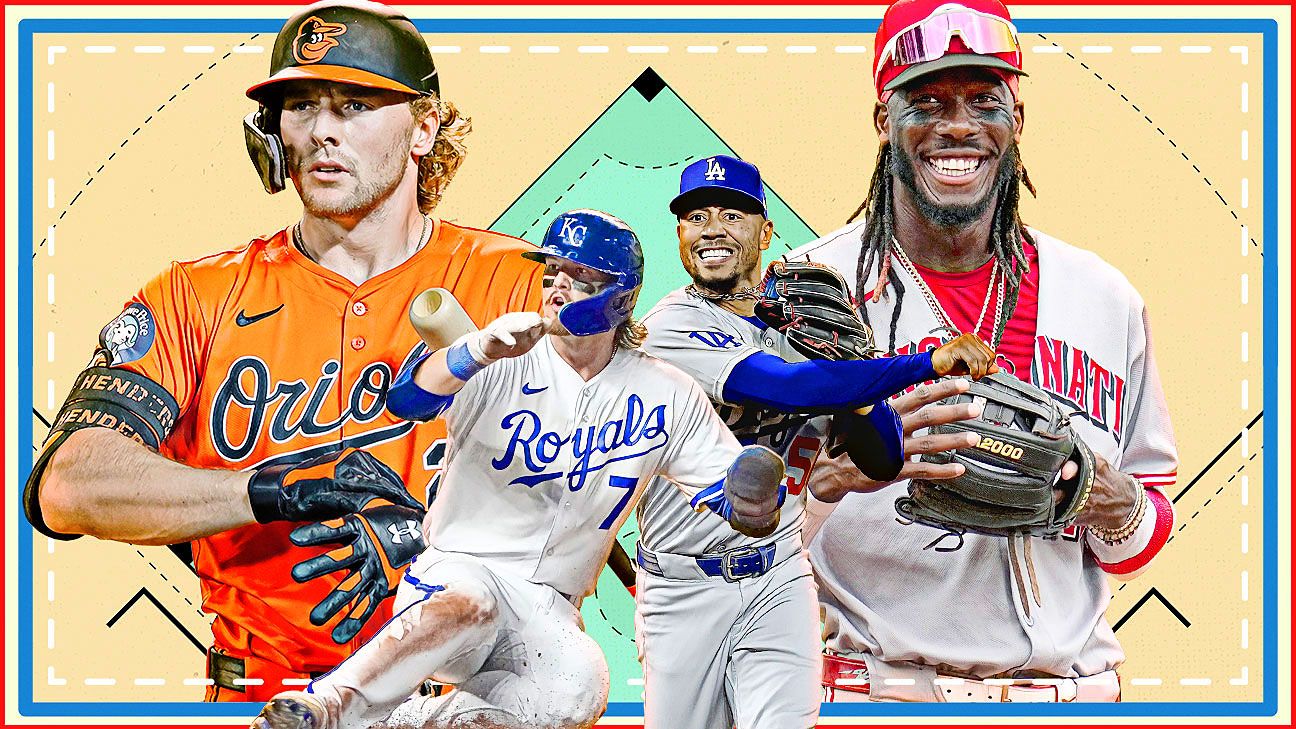
A statistical breakdown of the league's premier shortstops, highlighting the battle for the top spot between Bobby Witt Jr. and Gunnar Henderson.
Bobby Witt Jr. enters the 2024 conversation as a statistical marvel, having secured a 30-30 season with 30 home runs and 49 stolen bases during his sophomore campaign. The Kansas City Royals cornerstone recorded a .495 slugging percentage and led the American League with 11 triples, establishing a baseline for the modern power-speed archetype at the six-spot. His defensive metrics showed significant improvement, tallying 14 Outs Above Average (OAA) to complement his offensive production. This combination of elite sprint speed, measured at 30.5 feet per second, and raw power places him at the forefront of the shortstop hierarchy.
Gunnar Henderson challenges for the summit following a Rookie of the Year performance that included 28 home runs and 100 runs scored for the Baltimore Orioles. The left-handed hitter posted a .814 OPS and accumulated 6.3 Baseball-Reference WAR, proving his versatility by splitting time between third base and his primary middle infield role. Henderson’s 53 extra-base hits underscored his ability to drive the ball to all fields, while his 123 OPS+ indicated he was 23 percent better than the league-average hitter. His arm strength remains a standout tool, frequently clocked in the 90th percentile among all major league infielders.
Geraldo Perdomo represents the high-floor defensive specialist in this elite grouping, coming off an All-Star selection with the Arizona Diamondbacks. While his power numbers—consisting of six home runs—trail the leaders, his .353 on-base percentage reflects a disciplined approach at the plate characterized by 64 walks. Perdomo’s value is anchored in his glovework, where he contributed to a defensive unit that reached the World Series. He maintained a steady presence in the lineup, appearing in 144 games and providing the stability necessary for a pennant-winning infield.
The depth of the position extends to veterans like Francisco Lindor, who produced a 30-30 season of his own with 31 homers and 31 steals for the New York Mets. Lindor’s 6.0 fWAR ranked among the highest for his position, supported by a .806 OPS and 98 RBIs. His durability is nearly unmatched, as he played 160 games while maintaining a .981 fielding percentage. The switch-hitter remains a dual-threat asset, combining veteran leadership with a power profile that has seen him surpass 25 home runs in five different seasons.
Corey Seager remains the offensive gold standard when healthy, evidenced by his .327 batting average and 1.013 OPS during the Texas Rangers' championship run. Despite playing only 119 games, he mashed 33 home runs and 42 doubles, earning World Series MVP honors for the second time in his career. Seager’s 170 OPS+ led all qualified shortstops, demonstrating a level of hitting proficiency that rivals elite first basemen. His presence in the middle of the order transforms the Rangers' lineup into one of the most dangerous units in professional baseball.
Rounding out the top tier, Trea Turner’s late-season surge in Philadelphia saw him finish with 26 home runs and a perfect 30-for-30 mark in stolen base attempts. After a slow start, Turner hit .337 with 16 homers over his final 48 games, reminding the league of his game-breaking speed and contact ability. Bo Bichette continues to be a hit machine for the Toronto Blue Jays, leading the American League in hits in previous seasons and maintaining a career .299 batting average. These athletes collectively represent a golden era for the shortstop position, where offensive output is now as critical as defensive range.
Stay informed
Follow SportsNow.
Join the reader list for future briefings and important newsroom updates.
Reader conversation
Your take on the story
Stay with the story