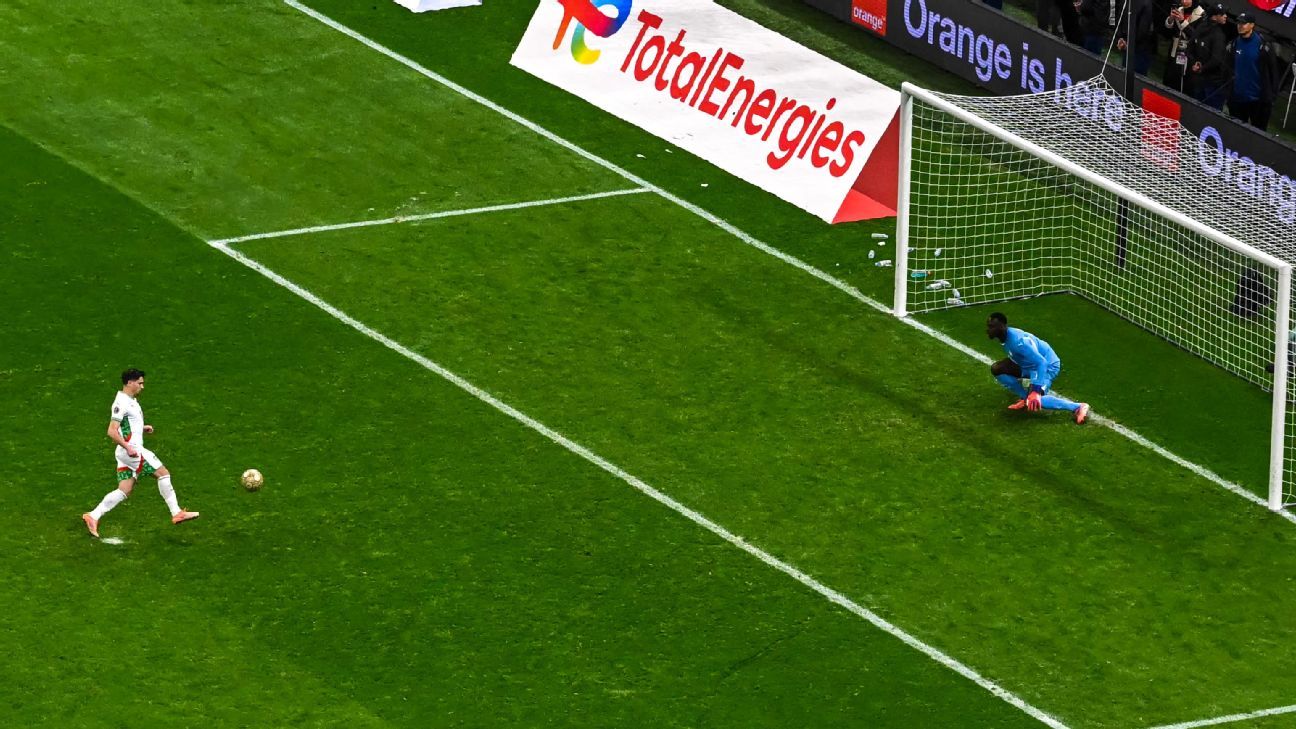
Morocco head coach Walid Regragui admits a prolonged delay before an injury-time penalty rattled Brahim Díaz, resulting in a failed panenka attempt.
Title: Frozen at the Spot: How the 'Penalty Clock' Derailed Brahim Díaz’s Bold Morocco Moment Category: SOCCER
It was designed to be the definitive exclamation point on a dominant performance. With Morocco leading deep into stoppage time, Brahim Díaz stepped up to the spot, ready to silence the doubters with the ultimate display of confidence: the Panenka. The audacious chip, a testament to a player brimming with self-belief, was meant to be a moment of pure individual brilliance, a flourish to cap off a strong showing for the Atlas Lions. However, the Real Madrid star’s bold attempt lacked the necessary bite, floating meekly into the grateful arms of the opposing goalkeeper. The anticlimactic finish left fans and pundits alike wondering what went wrong with the usually clinical playmaker, especially given his reputation for composure in high-stakes situations. The missed Brahim Díaz penalty, while ultimately inconsequential to the match result, became a focal point of post-game discussion.
According to Atlas Lions head coach Walid Regragui, the failure wasn't a lack of technique or courage on Díaz's part, but rather a battle against the invisible clock of modern football. A lengthy VAR review, coupled with various on-field disruptions and player protests, meant Díaz was forced to wait an agonizing several minutes before the referee finally blew his whistle, signaling the official start of his run-up. Regragui noted that this extended period of inactivity "disturbed" his star midfielder, allowing doubt, overthinking, and a loss of crucial rhythm to creep into a moment that usually relies on pure, unadulterated instinct and split-second decision-making. The psychological toll of the delay on the Brahim Díaz penalty attempt was, in Regragui's view, profound.
“The wait was too long for him,” Regragui explained in the aftermath, offering a candid assessment of the situation. “When you have to wait three or four minutes to take a penalty, it breaks your rhythm and your focus. Brahim is a player who thrives on momentum, on feeling the flow of the game, and that pause fundamentally changed the psychology of the strike.” The coach, ever supportive of his players, remained steadfast in his backing of Díaz. He emphasized that while the execution of the Brahim Díaz penalty ultimately failed, the ambition to take responsibility in such a high-pressure moment, to even attempt a Panenka, remains a vital and commendable asset for the national team. This willingness to step up, even when things don't go to plan, speaks volumes about Díaz's character and leadership qualities within the squad.
Despite the missed opportunity to pad the scoreline and add a flourish to their victory, Morocco walked away with the deserved win. However, the incident serves as a cautionary tale regarding the increasingly fragmented pacing of the modern game. For Díaz, it is a rare blemish in what has otherwise been a seamless and highly successful transition into the Moroccan national team setup, where he has quickly established himself as a key creative force. As the team looks ahead to their next international fixtures and crucial qualifying matches, the focus will likely shift from the miss itself to ensuring the squad, and individual players like Díaz, can maintain their composure, concentration, and mental sharpness during the increasingly frequent 'dead air' moments that characterize VAR-era football. The impact of these delays on critical moments, such as a Brahim Díaz penalty, is becoming an undeniable factor.
The Psychological Toll of the Penalty Delay
The concept of "rhythm" and "focus" in football, particularly for set-piece specialists, is often underestimated. A penalty kick, while seemingly simple, is a highly choreographed moment of intense pressure. Players often have pre-determined routines, a specific number of steps, a mental checklist they run through in the seconds leading up to the strike. This routine instills confidence and allows the player to execute the shot almost subconsciously. When this routine is abruptly interrupted, as it was for the Brahim Díaz penalty, the mental framework can crumble. The extended wait forces the player out of their "zone." Instead of focusing purely on technique and placement, their mind might wander, considering the implications of the miss, the goalkeeper's movements, or even the sheer duration of the delay itself.
This mental interference can manifest in subtle but significant ways. A slight hesitation in the run-up, a fraction of a second's delay in striking the ball, or even a minor adjustment to the intended target can be enough to turn a perfectly executed shot into a tame effort. For a Panenka, which relies entirely on deception and a delicate touch, any loss of confidence or overthinking can be fatal. The goalkeeper, having watched Díaz wait for an extended period, might also gain an advantage, sensing the player's unease or having more time to analyze his body language. The incident with the Brahim Díaz penalty highlights how the human element, specifically the psychological state of the player, can be profoundly affected by external factors like VAR delays, turning a moment of anticipated glory into one of frustration.
The Broader Implications for VAR and Game Flow
The Brahim Díaz penalty incident isn't an isolated case but rather a symptom of a larger issue facing modern football: the impact of VAR on the game's flow and player psychology. While VAR was introduced to ensure fairness and correct clear and obvious errors, its implementation has undeniably introduced prolonged stoppages that can disrupt momentum, cool down players, and alter the emotional temperature of a match. For attacking players, who thrive on continuous action and quick transitions, these breaks can be particularly jarring.
Coaches and sports psychologists are increasingly having to factor these delays into their preparation. How do you keep players "switched on" during a three-minute VAR review? What strategies can be employed to help a player maintain focus when a critical moment, like a penalty, is put on hold? The challenge extends beyond just the penalty taker; the entire team can be affected, losing their intensity or tactical discipline during these lulls. The case of the Brahim Díaz penalty serves as a powerful reminder that while technology aims to perfect the game, it must also consider the intricate human element that defines it. Future discussions around VAR implementation may need to explore mechanisms to minimize these psychological disruptions, perhaps through clearer communication, more efficient review processes, or even designated "cooling off" periods that are universally understood and managed. The balance between accuracy and maintaining the natural rhythm of the game remains a crucial and ongoing debate.
Stay informed
Follow SportsNow.
Join the reader list for future briefings and important newsroom updates.
Reader conversation