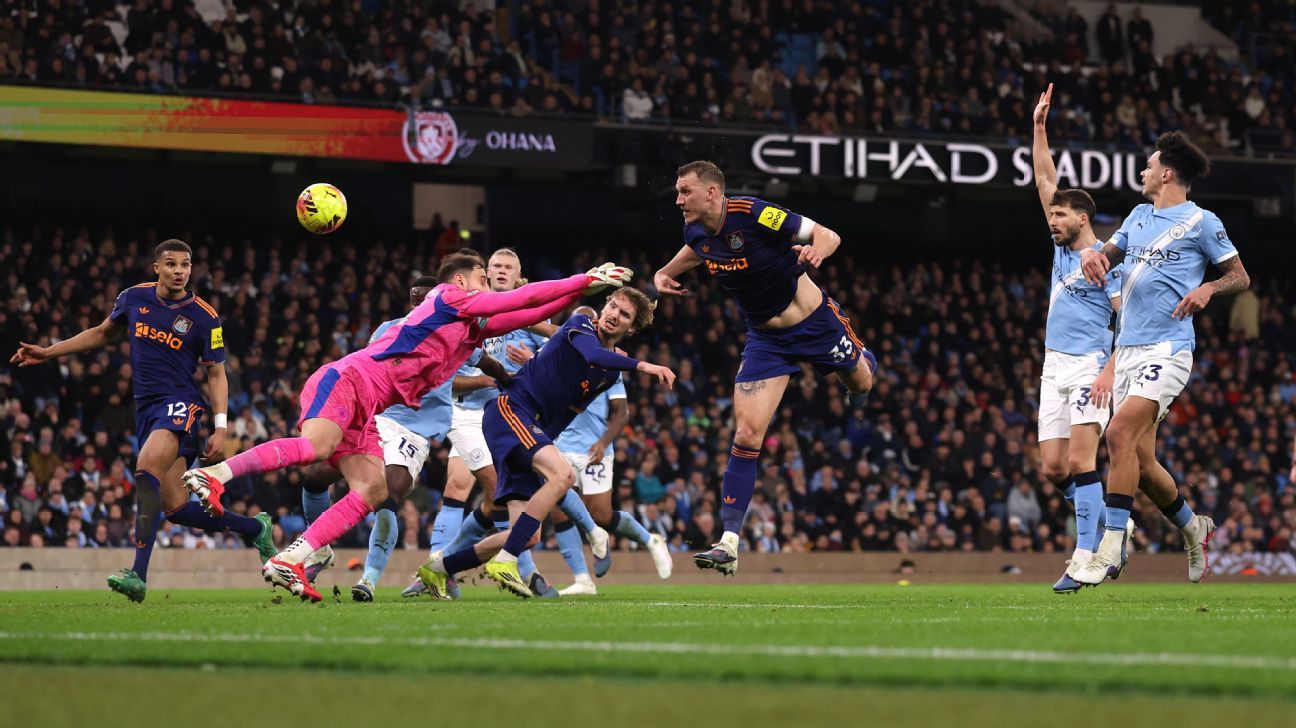
Newcastle defender Dan Burn had a 42nd-minute goal disallowed for offside after being pushed by Manchester City’s Rúben Dias.
Manchester City secured a victory against Newcastle in a Premier League match marked by two significant officiating reviews involving referee Tom Bramall and VAR James Bell. In the 42nd minute, Newcastle defender Dan Burn saw his equalizing goal disallowed after he nodded home a free kick delivered by Sandro Tonali. While Burn was physically in an offside position at the moment of the strike, video replays confirmed that Manchester City defender Rúben Dias had deliberately pushed the Newcastle player into that illegal position prior to the ball being played.
Despite the clear and deliberate nature of the push by Dias, the VAR check cleared the on-field decision of no goal. The technical rationale for this decision centered on Law 12 of the Laws of the Game, which dictates that direct free kicks or penalty kicks can only be awarded for offenses committed while the ball is in play. Because Tonali had not yet struck the free kick when Dias initiated the contact, the ball was considered inactive. This timing prevented VAR from intervening to suggest a penalty, as the push occurred during a dead-ball situation.
Tactical Analysis of the Offside Incident
The incident at the 42-minute mark highlighted a calculated defensive maneuver by the Manchester City backline. By timing the physical contact to occur exactly before the ball entered active play, Dias ensured that his actions fell outside the jurisdiction of the Video Assistant Referee. Under current protocols, VAR cannot penalize physical contact before the ball is in play unless the action constitutes violent conduct. As the push did not meet the threshold for violent conduct, the responsibility for managing the contact rested solely with the on-field referee, Tom Bramall, rather than James Bell in the VAR booth.
Former Select Group referee Andy Davies noted that the City defenders appeared to understand the specific nuances of the law. By pushing Burn into an offside position while the ball was stationary, they effectively neutralized the scoring threat without risking a VAR-mandated penalty. This left Newcastle players and supporters feeling aggrieved, as the offside offense was a direct result of an unpunished foul that occurred seconds before the goal was scored.
Bernardo Silva Avoids Second Yellow Card
Controversy continued in the 51st minute when Manchester City midfielder Bernardo Silva, who had already been cautioned earlier in the match, jumped into Dan Burn. Replays indicated that Silva made no attempt to play the ball during the challenge. Despite the nature of the tackle, referee Tom Bramall opted not to issue a second yellow card, which would have resulted in a red card and a dismissal for the Portuguese international.
Under the current Premier League VAR protocols, James Bell was unable to intervene in this specific instance. The VAR is only permitted to review potential straight red card offenses and has no authority to recommend a second yellow card. Consequently, the on-field decision stood, and Silva remained on the pitch. Analysis of the clip suggests that while the challenge was unnecessary and lacked an attempt to win possession, it did not reach the high threshold required for a VAR to classify it as a straight red card offense.
Refereeing Thresholds and Game Management
The decision to keep Silva on the field was described as a matter of game management by officiating experts. For a referee to dismiss a player for a second caution in a high-stakes Premier League game, the challenge must typically be a standout moment that leaves no doubt in the official's mind. Bramall’s choice to allow play to continue without a second booking reflected his real-time assessment of the game's physical context.
While Silva was considered fortunate to avoid a red card given he did not play the ball, the lack of VAR jurisdiction over yellow cards meant the decision could not be overturned. This match serves as a case study for how the timing of fouls relative to the ball being in play and the limitations of VAR protocols regarding cautions can significantly influence the outcome of Premier League fixtures. Manchester City's title aspirations remain bolstered by the win, while Newcastle was left to rue the technicalities that saw a goal struck off and an opponent remain at full strength.
Stay informed
Follow SportsNow.
Join the reader list for future briefings and important newsroom updates.
Reader conversation
Your take on the story
Stay with the story
Related coverage
Open desk
Van Dijk Maintains Rivalry View Following 3-0 Loss to Manchester City
Maresca Defends Manchester City Celebrations Following 3-0 Victory at Anfield