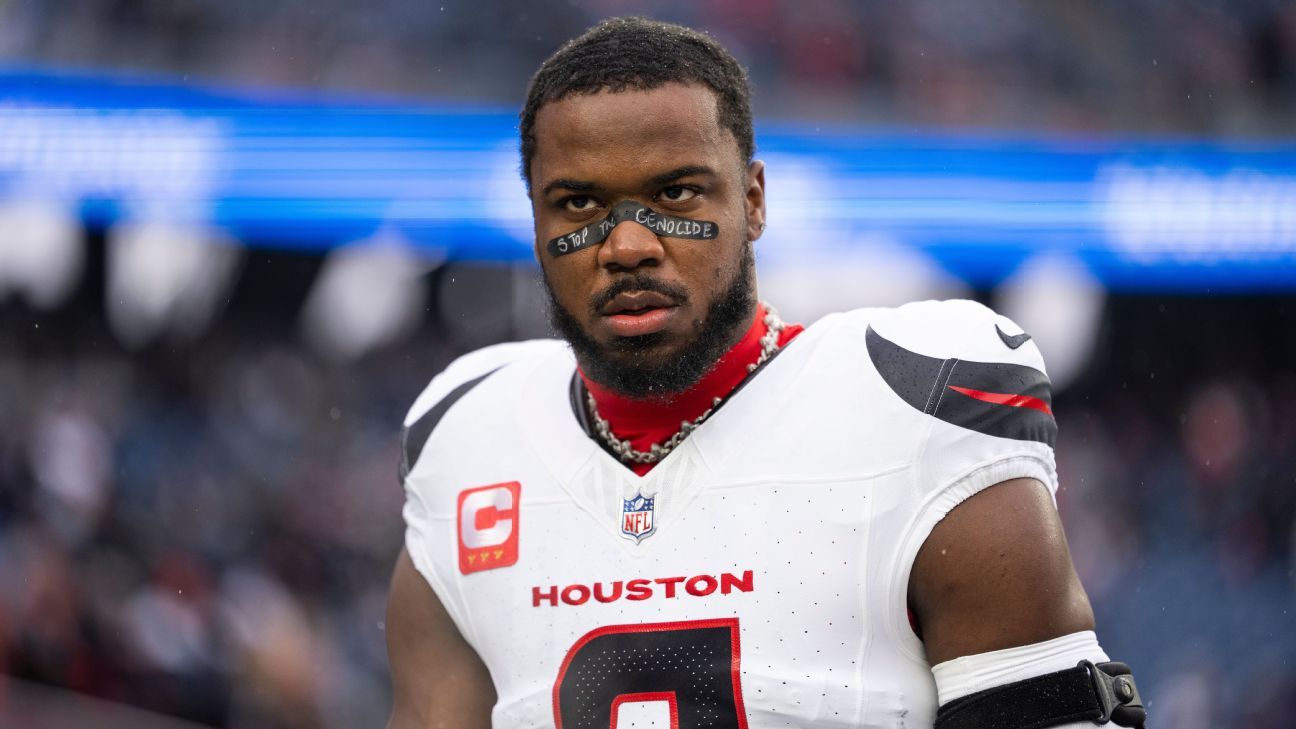
Despite a reported hit to his wallet from the NFL front office, Texans linebacker Azeez Al-Shaair used his postseason platform to double down on a personal plea for peace.
Conviction Over Cash: Azeez Al-Shaair Defies League Fine to Repeat Eye Black Message
In the high-stakes theater of the NFL postseason, where every play is scrutinized and every detail magnified, every square inch of a player’s uniform is governed by a strict league dress code. From helmet decals to sock height, the NFL meticulously controls its visual presentation. However, Houston Texans linebacker Azeez Al-Shaair has decided that some messages are worth more than the price of a fine, even in the unforgiving environment of playoff football. For the second consecutive week, Al-Shaair took the field with a poignant, hand-scrawled directive across his eye black: “Stop the genocide.” This bold statement, visible to millions, underscores a deep conviction that transcends the boundaries of professional sports.
The defiant display comes on the heels of reports that the NFL fined the veteran defender following his initial use of the message during Houston’s thrilling Wild Card victory. While the league typically maintains a rigid stance against unapproved personal messaging on gameday attire – a policy designed to uphold sponsor agreements, maintain a unified brand image, and prevent potentially divisive statements – Al-Shaair appears unmoved by the financial repercussions. Instead of backing down, he strategically chose the Divisional Round's massive television audience, a platform reaching tens of millions of viewers, to amplify his call for humanitarian awareness. The initial Azeez Al-Shaair fine, while a deterrent for many, clearly failed to silence his voice.
Al-Shaair has long been known as a vocal leader in the locker room, a player whose influence extends beyond his on-field performance. He's respected by teammates and coaches alike for his integrity and commitment. However, this silent protest, emblazoned across his face, represents his most public and impactful foray into global advocacy. By reapplying the paint for the Texans' high-profile clash against a formidable opponent, he has effectively turned his face into a living billboard for a cause that profoundly transcends the gridiron, sparking widespread conversation across social media platforms, sports broadcasting networks, and mainstream news outlets. The visibility of the Azeez Al-Shaair fine and his subsequent defiance has only intensified the spotlight on his message.
As the NFL continues to navigate the fine line between allowing player expression and enforcing corporate uniformity, a tension that has historically manifested in various ways, Al-Shaair’s persistence sets up a potential showdown with league officials. The league's disciplinary actions are often a delicate balance of maintaining order and avoiding public relations backlashes. Whether additional, escalating fines will follow, potentially increasing the financial burden on Al-Shaair, remains to be seen. But for now, the Texans' linebacker has made his priorities abundantly clear: the weight of the world carries far more significance than the weight of his paycheck, or the sting of an Azeez Al-Shaair fine.
The NFL's Stance on Player Expression and Its Precedents
The NFL's policy on personal messages displayed by players is well-documented and frequently enforced. The league's operations manual explicitly prohibits players from displaying messages that are not approved by the league, especially those of a political, religious, or personal nature. This stance is rooted in a desire to maintain a neutral, unified image for the league and its partners, and to avoid situations where the NFL might be perceived as endorsing specific viewpoints. While players are encouraged to engage in community service and charitable work off the field, the gameday environment is tightly controlled.
Historically, the league has issued fines for various infractions, from uniform violations like un-tucked jerseys and non-standard cleats to more impactful displays. Colin Kaepernick's kneeling during the national anthem, while not a uniform violation, sparked a national conversation about player protest and freedom of speech within the league's framework. More recently, players have been fined for wearing unapproved cleats to honor causes, or for displaying messages on undershirts. The Azeez Al-Shaair fine for his eye black message falls squarely within this established pattern of enforcement. The league's challenge lies in balancing its desire for control with the growing public expectation for athletes to use their platforms for social good. Al-Shaair's actions force this conversation into the forefront during the league's most watched games.
The Broader Impact and Public Reaction
The decision by Azeez Al-Shaair to continue his protest, despite the financial penalty, has resonated deeply with various segments of the public. On one hand, many fans and human rights advocates have lauded his courage and conviction, praising him for using his prominent platform to highlight a critical global issue. Social media has been awash with messages of support, with many commending his moral stand and criticizing the NFL for perceived attempts to silence humanitarian concerns. This support underscores a growing sentiment that athletes, given their immense reach, have a responsibility to speak out on important societal matters.
Conversely, some traditionalists and a segment of the audience believe that sports should remain apolitical, arguing that the field is not the place for such messages. They contend that players should focus solely on the game, and that the league is justified in enforcing its rules to maintain the integrity of the sport. The debate surrounding the Azeez Al-Shaair fine thus encapsulates a larger cultural discussion about the role of athletes in activism and the boundaries of free expression within professional sports. His repeated message ensures that this discussion continues, not just in sports circles, but across broader societal platforms. The visibility of his protest during the NFL playoffs guarantees that the "Stop the genocide" message reaches an audience far beyond what a typical activist might achieve, highlighting the unique power of an athlete's platform. This ongoing defiance, despite the financial cost, elevates Al-Shaair from just a football player to a significant voice in global advocacy.
Stay informed
Follow SportsNow.
Join the reader list for future briefings and important newsroom updates.
Reader conversation