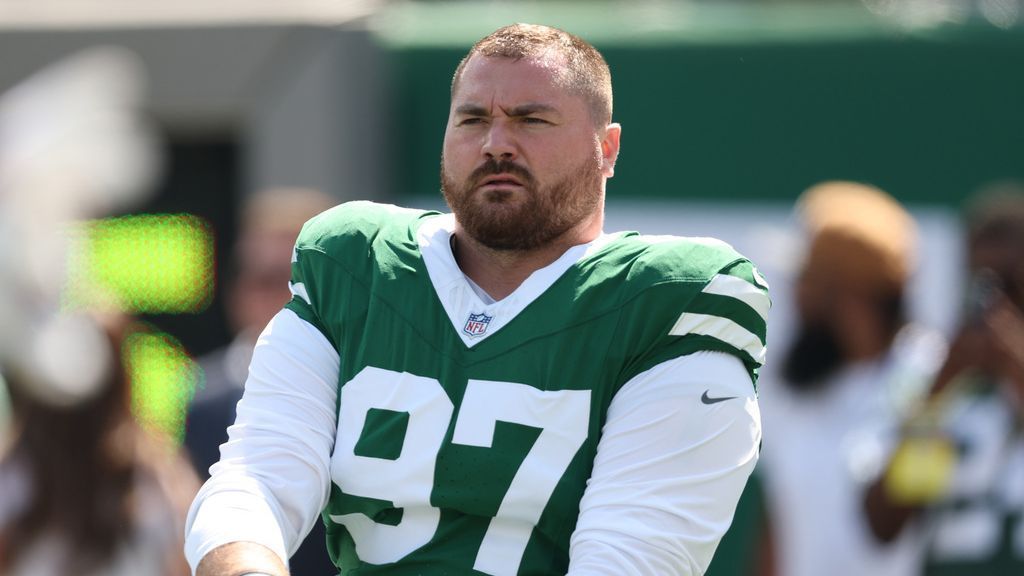
New York Jets defensive tackle Harrison Phillips didn't hold back when discussing the team's historical struggles, highlighting deep-seated Jets culture issues.
The New York Jets find themselves at a critical crossroads as they attempt to redefine their identity under a new coaching regime. However, according to veteran defensive tackle Harrison Phillips, the road to redemption is paved with more than just tactical adjustments. In a recent candid interview, Phillips shed light on the pervasive Jets culture issues that have haunted the franchise for years, describing the locker room environment inherited by first-year coach Aaron Glenn as nothing short of "cancerous."
Phillips’ comments have sent shockwaves through the NFL community, providing a rare, unvarnished look at the internal rot that can occur within a losing organization. For a team that has struggled to find its footing in a competitive AFC East, these revelations suggest that the problems in Florham Park were never just about missed tackles or poor play-calling; they were systemic and psychological.
The Roots of the 'Cancerous' Environment
When Aaron Glenn took the reins, he wasn't just stepping into a new job; he was entering a battlefield of low expectations and historical baggage. Phillips emphasized that the Jets culture issues were not the result of a single bad season, but rather a cumulative effect of years of losing. In professional sports, losing can become a habit, and once that habit settles into the walls of a facility, it becomes incredibly difficult to excise.
"It’s hard to explain to people who aren't in that room every day," Phillips remarked during his media availability. "You’re fighting against a ghost. You’re fighting against a feeling that no matter what you do, the result is going to be the same. That’s what Aaron [Glenn] walked into. He inherited a group where that mentality had become cancerous. It eats away at the new guys, it eats away at the work ethic, and it makes it nearly impossible to build something sustainable."
This "cancerous" label is particularly damning in the context of professional football, where chemistry and mutual accountability are the bedrocks of success. If the veteran leadership and the core of the roster are infected with apathy or a defeatist attitude, even the most brilliant schemes from a defensive coordinator like Glenn will fall on deaf ears.
Aaron Glenn’s Uphill Battle for Change
For Aaron Glenn, the task at hand is twofold: he must improve the product on the field while simultaneously performing a complete cultural lobotomy on the organization. Addressing the Jets culture issues requires more than just a "rah-rah" speech; it requires a systematic removal of players who do not buy into the new vision and a reinforcement of those who do.
Glenn, known for his intense energy and high football IQ, has been tasked with bringing a sense of pride back to the Jets' defense. However, as Phillips pointed out, you cannot build a house on a cracked foundation. The first year of Glenn’s tenure has been as much about evaluating character as it has been about evaluating talent. The coaching staff is looking for players who are tired of the status quo and are willing to do the uncomfortable work required to change a narrative.
Transitioning from a "cancerous" group to a winning one often involves a high turnover rate. We are seeing the early stages of this in New York, as the front office and coaching staff prioritize "culture fits" over raw athleticism. The goal is to create an environment where the Jets culture issues of the past are viewed as a distant, unpleasant memory rather than a recurring nightmare.
Overcoming the Franchise’s Losing History
The weight of history is a heavy burden for any athlete. For the Jets, the lack of recent postseason success has created a vacuum where negativity thrives. Phillips noted that the difficulty in getting over the franchise's losing culture is that the outside noise often mirrors the internal frustration. When the media and the fans expect failure, it becomes a self-fulfilling prophecy for the players.
To break this cycle, the team must find small victories. Whether it’s a dominant defensive stand or a disciplined week of practice, these moments serve as the antidote to the Jets culture issues described by Phillips. The veteran defensive tackle believes that while the progress is slow, it is finally happening. By identifying the "cancer" and calling it out publicly, Phillips is essentially drawing a line in the sand. He is signaling that the old way of doing things is no longer acceptable.
The Road Ahead for the Jets Defense
As the season progresses, all eyes will be on how the locker room responds to these blunt assessments. Will the remaining players take Phillips' words as a challenge to improve, or will it create further friction? For Aaron Glenn, the hope is that this honesty serves as a catalyst for a total transformation.
Ultimately, solving the Jets culture issues will be the defining metric of the current coaching staff's success. If they can turn a "cancerous" group into a cohesive, winning unit, it will be one of the greatest organizational turnarounds in recent NFL history. Phillips has laid the cards on the table; now, it is up to the players and coaches to play the hand they’ve been dealt and finally move past the shadows of the past.
Stay informed
Follow SportsNow.
Join the reader list for future briefings and important newsroom updates.
Reader conversation