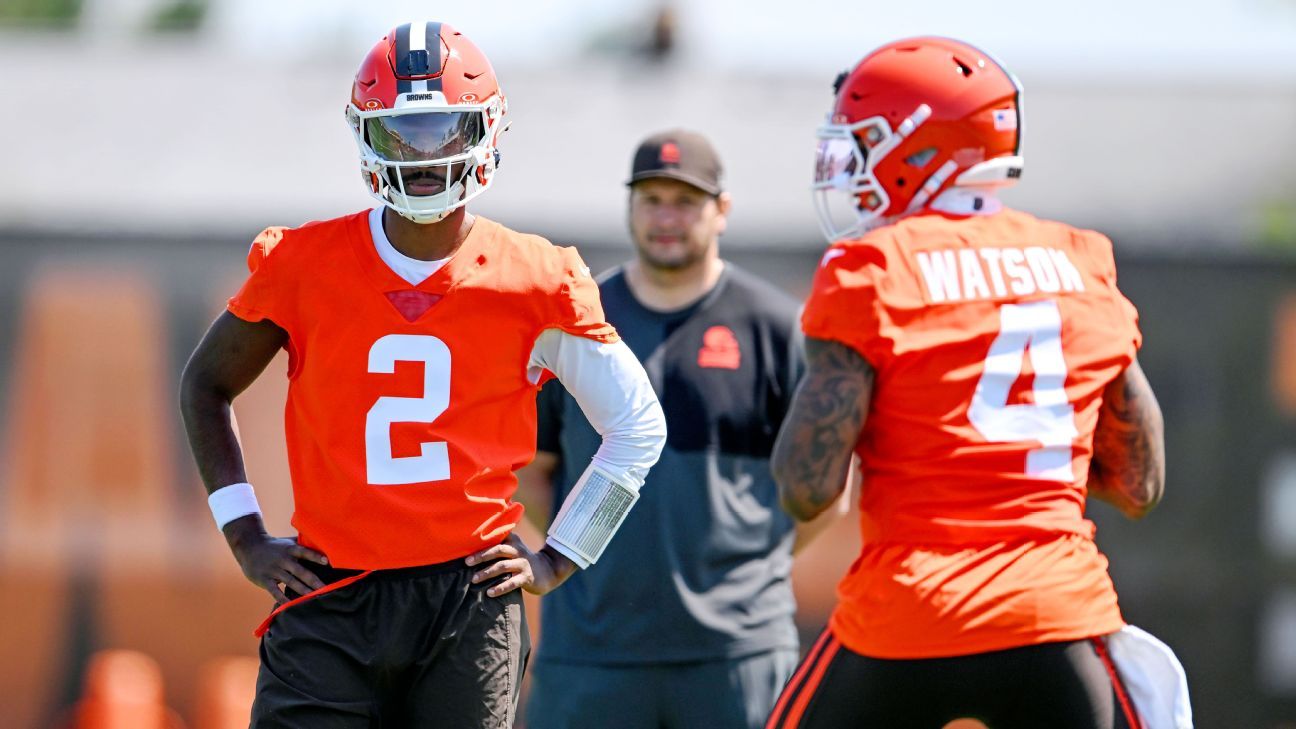
Offensive coordinator Todd Monken reveals that practice repetitions will not be divided equally among the three primary contenders for the Browns' starting job.
Todd Monken has officially declared that the Cleveland Browns quarterback competition will not feature a symmetrical distribution of practice repetitions during the upcoming offseason program. The three-way battle involves incumbent Deshaun Watson, rookie Shedeur Sanders, and newcomer Dillon Gabriel. Rather than implementing a rigid 33.3 percent split for each signal-caller, the coaching staff intends to allocate snaps based on specific evaluation criteria. This tactical decision ensures that the volume of work for each passer will fluctuate throughout the spring and summer sessions, prioritizing situational needs over mathematical parity.
During the initial phases of organized team activities (OTAs), the coaching staff will monitor how Watson, Sanders, and Gabriel handle the installation of the expanded playbook. Monken emphasized that the goal is not to provide a fair environment, but an effective one for determining the depth chart hierarchy. Consequently, one player might take 40 percent of the first-team snaps on a Tuesday, only to see that number drop significantly by Thursday. This fluid approach allows the offensive assistants to focus on specific mechanical adjustments or chemistry-building exercises with the receiving corps without the burden of maintaining equal play counts.
Deshaun Watson enters this phase looking to reclaim his status as the undisputed leader of the offense, yet the presence of high-profile additions like Sanders and Gabriel complicates the landscape. The lack of equal reps suggests that the Browns are moving toward a merit-based system where performance in individual drills directly influences the quantity of team-period opportunities. If a particular quarterback demonstrates superior command of the two-minute drill, he may receive a disproportionate share of those specific repetitions. This strategy forces all three athletes to maximize every single drop-back, as the total number of attempts is no longer guaranteed.
Shedeur Sanders and Dillon Gabriel represent two different developmental trajectories within this Cleveland roster. Sanders, transitioning from the collegiate ranks, requires a high volume of mental processing reps, while Gabriel brings a veteran-style efficiency from his extensive college career. Monken’s refusal to commit to even splits indicates that the team might front-load repetitions for the younger players to accelerate their learning curve or, conversely, lean on the veterans to establish a baseline rhythm. The discrepancy in snap counts will be most visible during 7-on-7 periods and full-team 11-on-11 simulations where timing is paramount.
By the time the mandatory minicamp concludes, the cumulative data from these uneven workloads will provide the foundation for the training camp battle in late July. The Browns' coaching staff is prioritizing the quality of the evaluation over the optics of equality. Every pass thrown by Watson, Sanders, or Gabriel is being tracked against a specific set of performance metrics that ignore the total volume of plays. This methodology ensures that the most prepared player emerges at the top of the roster, regardless of how many fewer or more snaps they received compared to their peers during the initial offseason workouts.
Stay informed
Follow SportsNow.
Join the reader list for future briefings and important newsroom updates.
Reader conversation
Your take on the story
Stay with the story