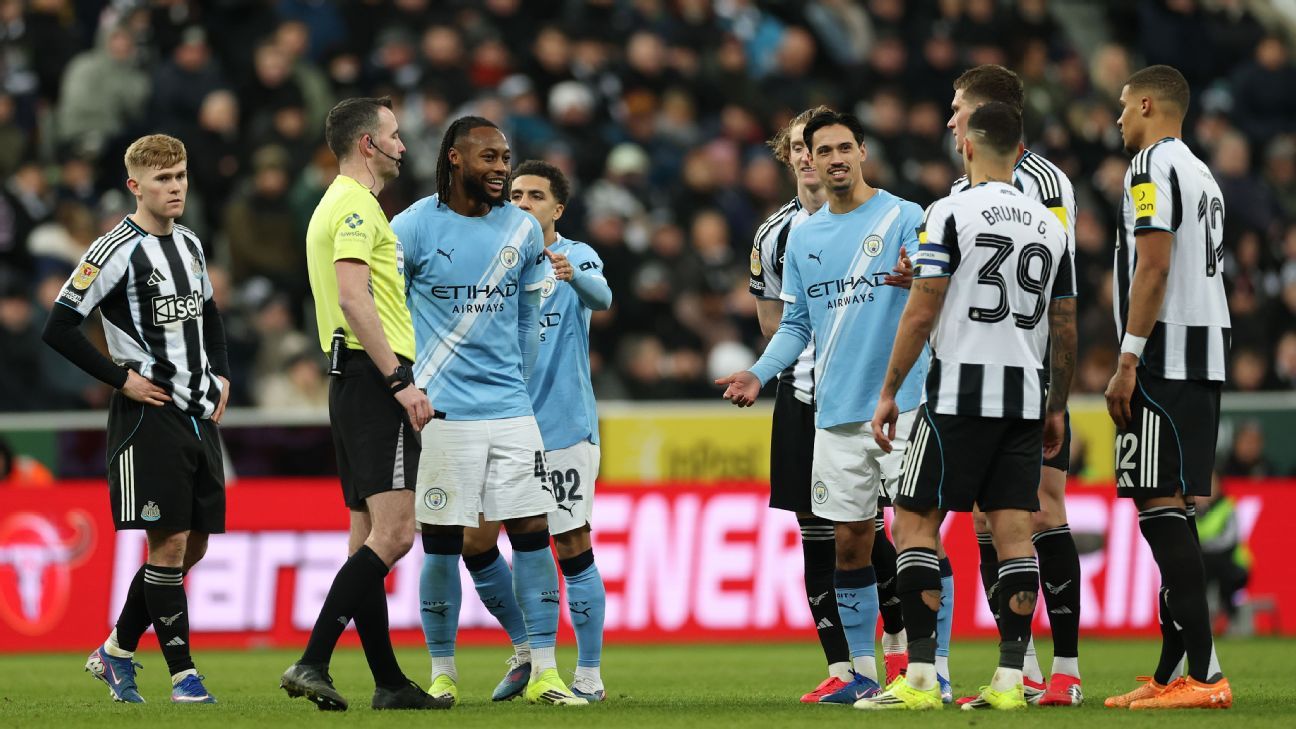
Fans were left questioning the pace of modern officiating after a lengthy VAR review at St. James' Park highlighted a surprising technological gap in English cup competitions.
Title: Stuck in the Slow Lane: Why VAR Lags Behind in the Carabao Cup Category: SOCCER
The high-octane drama of the Carabao Cup took an unexpected detour into frustration on Tuesday night as Newcastle United’s clash with Manchester City was marred by a grueling wait for justice. When the assistant referee’s flag eventually went up to chalk off a goal, the relief for the defending side was eclipsed by a growing conversation about the inconsistency of officiating technology across top-tier English football. This incident, while ultimately leading to the correct decision, highlighted a fundamental flaw in the application of VAR in the Carabao Cup, particularly when compared to its Premier League counterpart. The extended stoppage for a relatively straightforward offside call served as a stark reminder of the technological chasm that exists within English football's domestic competitions.
While Premier League fixtures have begun to embrace the lightning-fast efficiency of semi-automated offside technology (SAOT), the Carabao Cup remains tethered to the manual labor of the past. The delay in ruling out the strike wasn't just a matter of tight margins; it was a symptom of a competition operating without the digital 'God-eye' view that fans and players have come to expect at the highest level. The absence of SAOT at St. James' Park forced VAR officials to revert to the painstaking process of manually drawing lines on a screen—a method that feels increasingly archaic in the age of instant data. For the supporters in the stands and the millions watching at home, the several-minute hiatus drained the life out of a high-stakes encounter, turning a moment of sporting tension into a bureaucratic stalemate. This particular instance underscored the critical need for a more consistent approach to Carabao Cup VAR implementation.
The Cost of Inconsistency: Impact on Player and Fan Experience
The disparity in VAR technology between the Premier League and the Carabao Cup has far-reaching consequences beyond just the time taken for decisions. For players, the uncertainty and prolonged stoppages can disrupt their rhythm and concentration, especially in tightly contested matches. Imagine a scenario where a team builds momentum, scores a crucial goal, only for the celebration to be cut short by a multi-minute review that ultimately disallows it. This stop-start nature can significantly impact the flow of the game, turning what should be fluid, exciting football into a series of disconnected events. Players, accustomed to the swiftness of SAOT in league games, are left to contend with a slower, more manual process in cup competitions, which can be mentally taxing.
For fans, both in the stadium and watching remotely, the experience is equally, if not more, frustrating. The roar of the crowd, the surge of emotion that accompanies a goal, is often replaced by an anxious silence as everyone waits for the verdict. When the wait extends to several minutes, as it did in the Newcastle vs. Manchester City match, the energy dissipates. The atmosphere, a crucial element of live football, suffers immensely. Furthermore, the lack of transparency during these manual VAR checks can breed suspicion and resentment. Without the clear, immediate visual cues that SAOT provides, fans are left to trust a process that feels opaque and sluggish. This erodes faith in the officiating system and, by extension, the integrity of the Carabao Cup itself. The continued reliance on manual Carabao Cup VAR processes risks alienating a significant portion of the fanbase.
Financial Hurdles and Logistical Complexities
This technological disparity raises tough questions for competition organizers. As the gap between the 'haves' of the Premier League and the 'have-nots' of domestic cup tournaments widens, the integrity of the game's flow is at stake. Until the same elite tools are standardized across all major competitions, these agonizing technical delays will continue to be an an unwelcome guest at some of football’s biggest parties. The primary reason cited for the staggered implementation of advanced VAR technology, including SAOT, across English football is often financial. Installing and maintaining SAOT systems at every stadium used in the Carabao Cup, especially in earlier rounds where lower league clubs host matches, presents a significant logistical and financial challenge.
The Premier League, with its immense broadcasting revenues and commercial appeal, can afford to invest heavily in cutting-edge technology. The English Football League (EFL), which organizes the Carabao Cup, operates on a considerably smaller budget. Equipping every ground from the Championship down to League Two with the necessary cameras, calibration equipment, and trained personnel for SAOT would be an astronomical undertaking. Moreover, the sheer number of venues involved in the early stages of the Carabao Cup, compared to the fixed 20 Premier League stadiums, adds another layer of complexity. There's also the argument that the earlier rounds, often featuring lower-tier teams, are not deemed to require the same level of technological intervention as high-stakes Premier League clashes. However, as the competition progresses and Premier League teams enter, the inconsistency becomes glaringly apparent, creating the very issues highlighted by the Newcastle incident. The debate around Carabao Cup VAR funding and rollout will undoubtedly continue.
The question then becomes: where do we draw the line? Should the integrity of the game's flow and the fairness of decisions be compromised due to financial constraints? Or should a phased approach be considered, perhaps introducing SAOT from a specific round onwards, once only Premier League or Championship stadiums are guaranteed to be hosting matches? The current situation, where the standard of officiating technology fluctuates wildly depending on the competition, creates an uneven playing field and undermines the credibility of the Carabao Cup. It's a problem that demands a comprehensive solution, not just a temporary fix, to ensure that the excitement and drama of English cup football are not consistently overshadowed by outdated technology and prolonged, frustrating Carabao Cup VAR reviews.
Stay informed
Follow SportsNow.
Join the reader list for future briefings and important newsroom updates.
Reader conversation