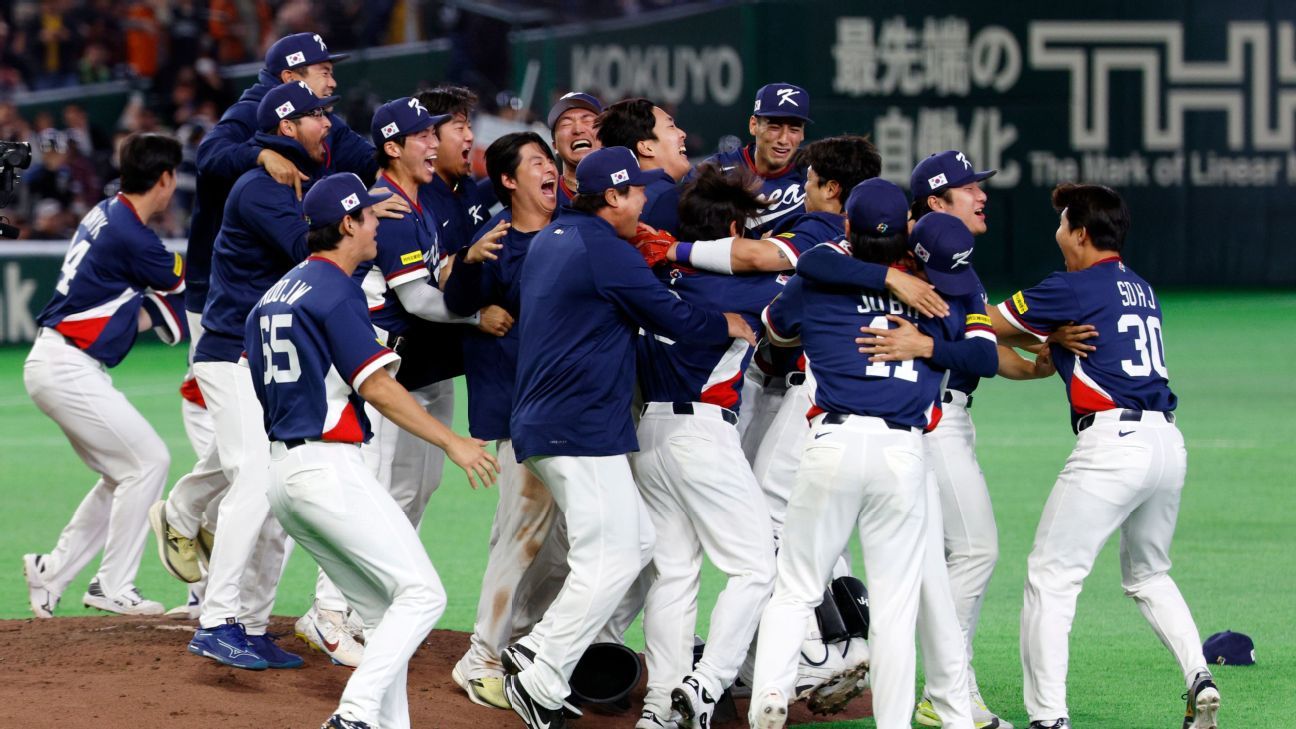
South Korea defeated Australia 7-2 at the Tokyo Dome to advance to the World Baseball Classic quarterfinals behind Bo Gyeong Moon’s 4-RBI performance.
South Korea secured a 7-2 victory over Australia on Monday at the Tokyo Dome, utilizing a precise five-run margin to navigate a complex tiebreaking system and advance to the World Baseball Classic quarterfinals. Bo Gyeong Moon spearheaded the offensive effort with a two-run home run and a total of four RBIs, bringing his tournament tally to 11. This win allowed South Korea to emerge from Pool C alongside Japan, ending a streak of three consecutive tournaments where the South Koreans failed to progress beyond group play. The final standings for Pool C saw South Korea, Australia, and Taiwan all finish with identical 2-2 records, necessitating the use of run-differential calculations to determine the runner-up behind the undefeated Japanese squad.
Under the specific tiebreaker rules governing the 2023 tournament, South Korea entered the contest needing a victory of at least five runs to leapfrog their opponents in the standings. Australia, conversely, would have advanced with a straight win or by limiting their margin of defeat to four runs or fewer. The 7-2 result precisely met the five-run threshold required for the South Korean side to clinch their spot in the next round. This mathematical necessity dictated every managerial decision throughout the nine innings, as a single run conceded by the Korean bullpen would have eliminated them regardless of the win-loss outcome.
South Korea established an early 4-0 lead within the first three innings of play. Bo Gyeong Moon’s early two-run blast in the second inning set the tone for an aggressive approach that forced Australia to cycle through three different pitchers during the opening three frames. In the fifth inning, Moon recorded his third hit of the game to drive in another run, extending the lead to 5-0 and marking the first time in the contest that South Korea held the necessary five-run cushion. Australian starter Lachlan Wells was charged with the loss after yielding the initial surge, while Ju Young Son earned the win for South Korea by navigating the middle innings with minimal damage.
Throughout the middle frames, Australia twice managed to reduce the deficit to four runs, a margin that would have seen them advance despite a loss. However, South Korea responded each time to restore the five-run gap required by the tiebreaking mathematics. The Australian lineup struggled to string together hits against the South Korean relief corps, which utilized five different pitchers to maintain the specific scoring gap. Every pitch in the late innings carried the weight of the entire tournament's progression, as the Tokyo Dome crowd watched the scoreboard as much as the field.
The deciding run of the game crossed the plate in the top of the ninth inning. Hae-Min Park reached third base following a throwing error by Australian shortstop Jarryd Dale, which kept the inning alive for the South Koreans. Hyun Min Ahn then delivered a sacrifice fly that allowed Park to score, providing the critical insurance run that pushed the score to 7-2. This seventh run proved to be the statistical barrier that Australia could not overcome, as it forced the Aussies to score twice in the bottom half of the frame to reclaim their quarterfinal spot.
Defensive precision in the bottom of the ninth proved just as vital as the offensive output. With an Australian runner on first base and one out, Rixon Wingrove hit a ball that appeared destined to be a double toward the right-field wall. Such a hit likely would have scored the runner from first, cutting the lead to four and sending Australia to the quarterfinals via the tiebreaker. However, South Korean right fielder Jung Hoo Lee executed a diving catch to record the out and preserve the 7-2 scoreline. This catch effectively ended Australia's hopes, as the subsequent batter grounded out to finalize the result.
This advancement marks a significant milestone for South Korean baseball, breaking a long-standing drought in the World Baseball Classic. While South Korea, Australia, and Taiwan finished group play at 2-2, the head-to-head and run-differential complexities favored the Koreans following this specific five-run victory. Japan remains the dominant force in the group with a 3-0 record heading into their final pool play matchup against Czechia. The South Korean team now prepares for a knockout stage matchup, having successfully navigated the most pressure-filled scenario of their Pool C campaign.
The aggressive strategy employed by the South Korean hitters early in the game successfully disrupted the Australian pitching rotation, which struggled to find stability after Wells' exit. By maintaining the five-run lead through the final out, South Korea ensured their first trip to the quarterfinal stage since 2009. The statistical anomaly of three teams finishing with identical records highlighted the importance of the ninth-inning insurance run provided by Ahn’s sacrifice fly. Without that final tally, the diving catch by Lee would have been a footnote in an elimination rather than the highlight of a tournament-saving victory.
Statistically, Bo Gyeong Moon’s performance ranks among the best single-game outputs in South Korean WBC history. His 11 total RBIs in the opening round provided the bulk of the team's offensive production. The South Korean pitching staff finished the game with eight strikeouts and allowed only six hits, a defensive efficiency that complemented the high-stakes offensive requirements. As the tournament moves to the quarterfinal round, the South Korean squad carries the momentum of a team that performed exactly to the mathematical requirements needed for survival under the most stringent tiebreaker conditions ever seen in international play.
Stay informed
Follow SportsNow.
Join the reader list for future briefings and important newsroom updates.
Reader conversation
Your take on the story
Stay with the story